
By Varun Patel, Founder & CEO of Crawlify | Oct 28, 2026 | 11 min read
Is That Auto Parts Price Drop Real? Read Competitor Price and Stock Together
Four online parts retailers promise to match a competitor’s lower price. All four add the same condition: the competitor must have the part in stock. Here is why that rule matters to every pricing and category team that watches competitor prices, and how to read price and stock as one signal.
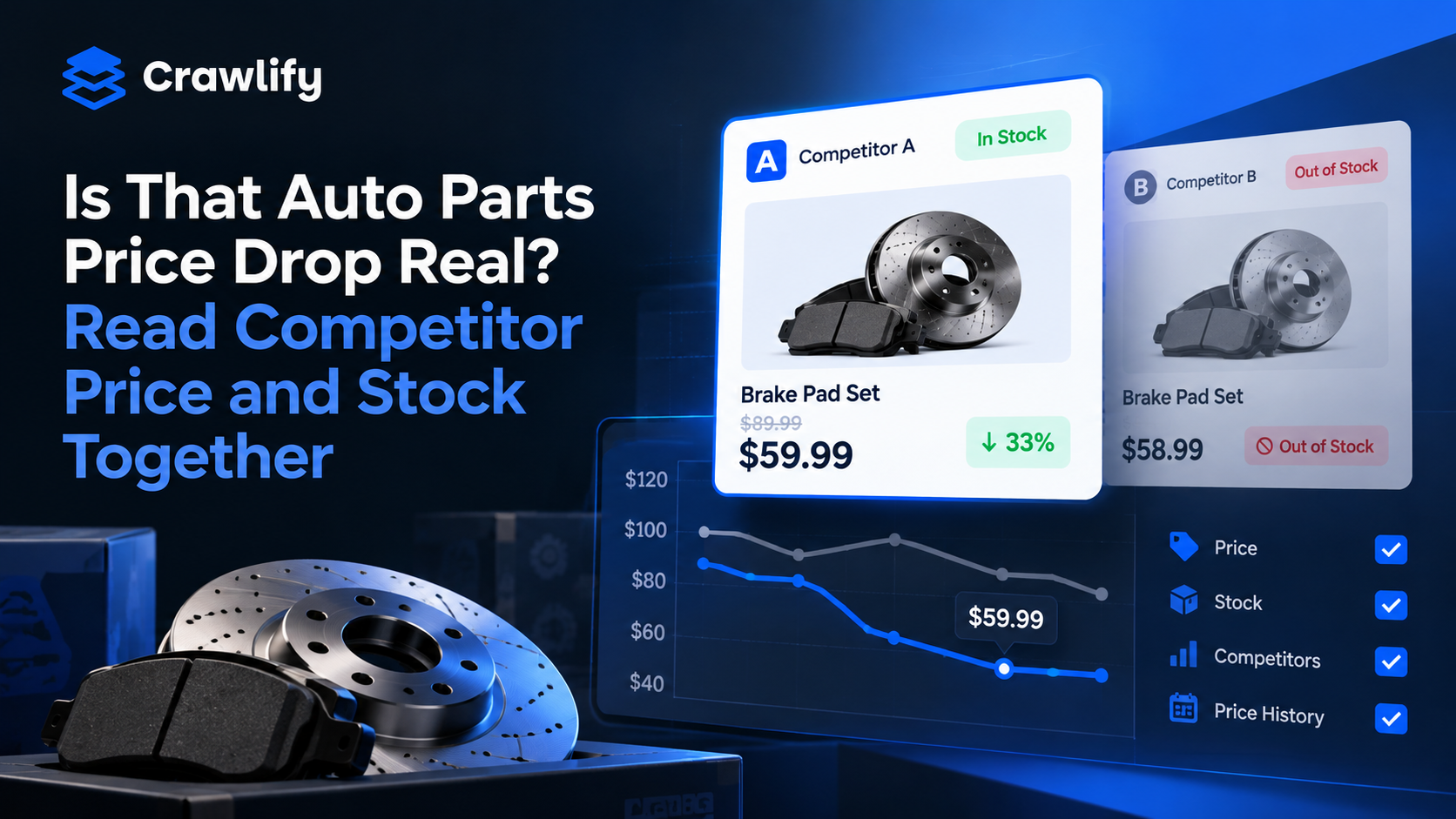
TL;DR — A price drop tells you a number changed. It does not tell you whether a customer can buy at that number. We read the public price-match terms of four online parts retailers, Eckler’s, JJ Motorsports, Springrates and Partzilla, and all four will match a competitor’s price only when the competitor has the part in stock. If businesses built around matching prices will not match a price they cannot buy, a pricing team should hold its own alerts to the same test. A cut on a part that is backordered, shipping in weeks or offered for pickup only does not change what your customers can buy, and a cut that is clearing the last few units changes very little, so reacting to either gives away margin for nothing. A cut on a part that stays deep in stock does change what they can buy. The reverse also holds: a competitor running out of stock is a move even when its price has not changed. This article sets out how to read price and stock together, five kinds of price drop that are not what they seem, what public stock signals can and cannot tell you, and how Crawlify.ai joins price and stock per part number so the alert reads “price dropped and stock is deep” instead of just “price dropped.”
Why a price drop alone is not a signal
It starts with an alert: a competitor has cut the price on a part you also sell. Someone has to decide whether to match it, wait or ignore it, and the alert carries a single fact. A number changed.
That is thin evidence at any time, and in 2026 price moves are coming from more directions. Dorman Products, a large aftermarket supplier, reported “targeted pricing actions” tied to a more stable tariff environment in its Q2 results, and management described price reductions that began in the quarter. A 15% cap on Section 232 duties for certain Taiwan-origin parts has applied since May 1. Cost relief does not reach every seller at once, so moves arrive from different sellers, at different times, for different reasons.
Most of those moves are worth knowing about. Far fewer are worth reacting to. The difference is rarely in the price itself. It is in what a customer can do at that price, and that is a question about stock.
What four price-match policies tell us
Price matching is a clean test of this idea. A retailer that promises to match a competitor’s lower price has to decide which competitor prices count, and it writes the answer into public terms. We read the terms of four online parts retailers in October 2026.
| Retailer | What its public price-match terms say |
|---|---|
| Eckler’s Corvette and classic Chevrolet parts |
The competitor must have the item “available for immediate purchase and shipment, not backordered or listed as a preorder.” Competitor items that are out of stock, on backorder or carry an estimated ship date are excluded, as is liquidation pricing. |
| JJ Motorsports Motorsports and truck parts |
The request must be for products “currently in stock at both JJ Motorsports and the competitor’s site.” Discontinued, clearance and final-sale items do not qualify. |
| Springrates Suspension parts |
“The item must be in stock and ready to ship from an authorized retailer.” Flash sales and liquidations are excluded. |
| Partzilla OEM parts |
“Item must be an OEM part and in stock at time of price match.” The competitor’s item must also ship directly to the customer, and pickup orders are not matched. Clearance and closeout items are excluded. |
How to read this. It is four retailers, not a survey of the market, and each row reflects one company’s published terms as we read them. For a business whose promise is to match competitors, a price counts only when the part can be bought, so stock is part of what makes a price real. All four also exclude clearance or liquidation pricing.
What it does not show. How often these retailers actually match, or how shoppers react to a competitor’s cut. It shows the rule each has written down. A pricing team can apply the same rule without writing a policy: before reacting to a competitor’s cut, ask whether the competitor can sell the part today.
What does “in stock” tell you on a public listing?
More than it seems, once it is treated as data. Availability is a structured field on a product page. The schema.org vocabulary used for product structured data defines twelve availability values, among them InStock, OutOfStock, LimitedAvailability, BackOrder, PreOrder, SoldOut, Discontinued and InStoreOnly. Google Merchant Center accepts four for most products (in_stock, out_of_stock, preorder and backorder) and requires availability to match across the landing page, structured data, checkout page and product feed, with a mismatch leading to disapproval. Sellers who advertise on Google therefore have a reason to keep their public status current.
Stock is not a yes or no, though. Three readings cover most of what a listing shows, and the alert uses the same words.
- Deep. The part is shown as available, there is no sign of rationing such as a low-stock note, the ship time is short, and the status has held across repeated checks.
- Thin. The part is available but the page shows strain: a low-stock note, a longer ship time, or a status that flips between checks.
- None. Out of stock, backorder, preorder, discontinued, or a ship date weeks away. A customer cannot buy it today.
Depth is a reading over time. One page load can say “in stock” whether the shelf holds two units or two hundred. A series of checks shows whether the status held, flickered or ran out. One look at a competitor’s page gives you the price and very little about the stock.
Put the three stock readings against the three things a price can do and you get nine outcomes. A price feed shows the rows. The columns decide what to do.
| Stock is deep | Stock is thin | Stock is none | |
|---|---|---|---|
| Price down | Real undercut Customers can buy it. Review your price. |
Likely a clearance Probably the last units. Watch it, do not chase it. |
Phantom cut Customers cannot buy it. Hold and keep watching. |
| Price up | Market moving up Check your margin. |
Possible scarcity pricing Check your own stock before you follow. |
Demand shifts to you Check your stock. |
| Price unchanged | No move Nothing to react to. |
Early warning The part may sell out, or be cut to clear. Watch. |
Competitor is out Demand shifts to you at today’s price. Check your stock. |
Five price drops that are not what they seem
The scenarios below are illustrations, not customer results. The retailer terms and listing fields they refer to are real.
Backordered cut. A competitor lowers the price on a brake pad set and the listing moves to backorder in the same update. At first glance it looks like a threat. Read with stock, it is not one yet. A customer who needs the part this week buys from a seller that has it.
Last-units clearance. A water pump falls to the lowest price on the market and the page shows a low-stock note. The cut is clearing the last units, not setting a new price. Matching it resets your price on a part the competitor is about to stop selling. All four policies above exclude clearance or liquidation pricing.
Stretched ship time. An alternator drops in price and still says in stock, but the estimated ship time moves from two days to three weeks. The part is listed, not available. Eckler’s excludes competitor items that carry an estimated ship date.
Pickup-only price. A lower price appears on a control arm, but it applies to store pickup and the price to ship to a customer has not moved. For an online buyer nothing changed. Partzilla does not match pickup prices, and schema.org lists InStoreOnly as its own availability value.
Pricing mistake. A headlight assembly shows at a fraction of its usual price and is corrected within hours. A weekly check either never sees it or sees it once and overreacts. Eckler’s and Partzilla both exclude competitor pricing errors.
A real one. The price drops on the same part number from the same brand, the status shows in stock, the ship time is short and the status holds across checks. That alert is worth a pricing review today.
A move with no price at all. A competitor’s part goes out of stock and the price does not change. Nothing alerts on a price feed, yet the competitor can no longer fill orders and demand moves toward you at today’s price. This is the move a price-only view cannot see.
What this does and doesn’t tell you
- It shows what is publicly listed: price, availability status, ship time and listing details that any visitor can see.
- It does not show a competitor’s warehouse count, costs, margins, or negotiated and account-specific pricing.
- A public status can lag the warehouse, or apply to one location only. We report what the listing showed and when, and read several cues together instead of trusting one.
- Deep is a reading of public cues over time. It is not a unit count, and we do not present it as one.
- A listed price is not always the price paid. A core charge (essentially a deposit on the reusable part, refunded once the old part is returned and passes inspection), coupons and shipping can sit outside the headline number.
- Matching the same part across sellers depends on part numbers, brand and fitment. Where a match is uncertain, we verify it before it is reported instead of guessing.
- It does not tell you what to charge. It shows what a customer can buy at a competitor’s price today. The pricing decision stays with your team.
How we join price and stock per part number
Crawlify.ai is a managed service. Your team does not configure crawlers. We agree the scope with you, run the monitoring and show what is being watched in a transparent monitoring view. Pricewire, our competitor-tracking solution for automobile and eCommerce companies, runs on the same engine.
Monitor. We watch the part numbers, competitors, marketplaces and brand sites you choose, at a cadence set per source. Collecting the pages is the easy layer. The next three decide whether the output is usable.
Detect. Each new record is compared with the previous one for the same part number: price, availability status, ship time and listing details. A change in any of them is a move, including a stock change with no price change.
Correlate. This is the step we think matters most. Price and stock are joined per part number into one signal, with fields mapped to your own schema so it arrives in your SKU terms. The alert reads “price dropped and stock is deep,” not just “price dropped.” A price pipeline on its own cannot say that, because it never saw the stock.
Act. The signal reaches your pricing and category team and the decision stays with them. Crawlify.ai monitors, structures and surfaces. It does not change prices or take actions on any site.
Verification sits underneath all four, and it matters more when two fields have to agree. A correct price joined to a wrong stock status still gives a wrong call. Each record carries a verifier ID and a timestamp under a 99.5% field-level accuracy SLA, so a pricing manager can trace a signal back to what was seen, and when.
The same three moves, as two kinds of alert:
| A price feed alone says | Price and stock joined says |
|---|---|
| Part ABC-1042: competitor price dropped. | Part ABC-1042: price dropped and stock is deep. |
| Part ABC-1043: competitor price dropped. | Part ABC-1043: price dropped, but the part is on backorder. |
| Part ABC-1044: no change. | Part ABC-1044: price unchanged, competitor is out of stock. |
Part numbers are illustrative.
Why continuous tracking beats the next manual check
Price and stock change on their own schedules. A competitor’s cut can sit live for hours or for weeks, and a weekly or monthly check sees where things ended up. It does not see when the price dropped, whether the stock was deep at that moment, or that the same part ran out two days later.
Depth also needs a series. Whether a status held, flickered or ran out only shows up across repeated checks, so tracking has to be continuous to say anything reliable about stock. Continuous tracking of publicly listed prices and availability across competitors, marketplaces and brand sites means a pricing team sees a move when it happens, not at the next manual check.
Start narrow. Pick one category where you are most often undercut, a short list of competitors and the marketplaces that matter to your sales. Crawlify.ai runs scoped 30-day pilots on a defined set of part numbers, so you can test whether the alerts show moves your team missed before committing to anything broader. See how Crawlify.ai tracks competitor price and stock.
See your own part numbers monitored. Share the category, the competitors and the marketplaces you care about, and we will scope a pilot around them. Talk to Crawlify →
Scenarios in this post are illustrations, not customer results. Retailer terms were read from each company’s public page in October 2026 and can change, so check the current page before relying on them.
Related reading: Pricing Auto Parts Amid Trade Uncertainty: How to See Competitor and Marketplace Moves Early
Frequently Asked Questions
