
By Varun Patel, Founder & CEO of Crawlify | Sep 23, 2026 | 9 min read
OEM vs. Aftermarket Pricing: What a Live Price Feed Actually Reveals About Where You're Losing the Sale
OEM parts cost about 50% more than aftermarket on average — but that number won't tell you which SKU, on which channel, is losing you the sale today. Here's what a live, SKU-level pricing feed actually reveals.
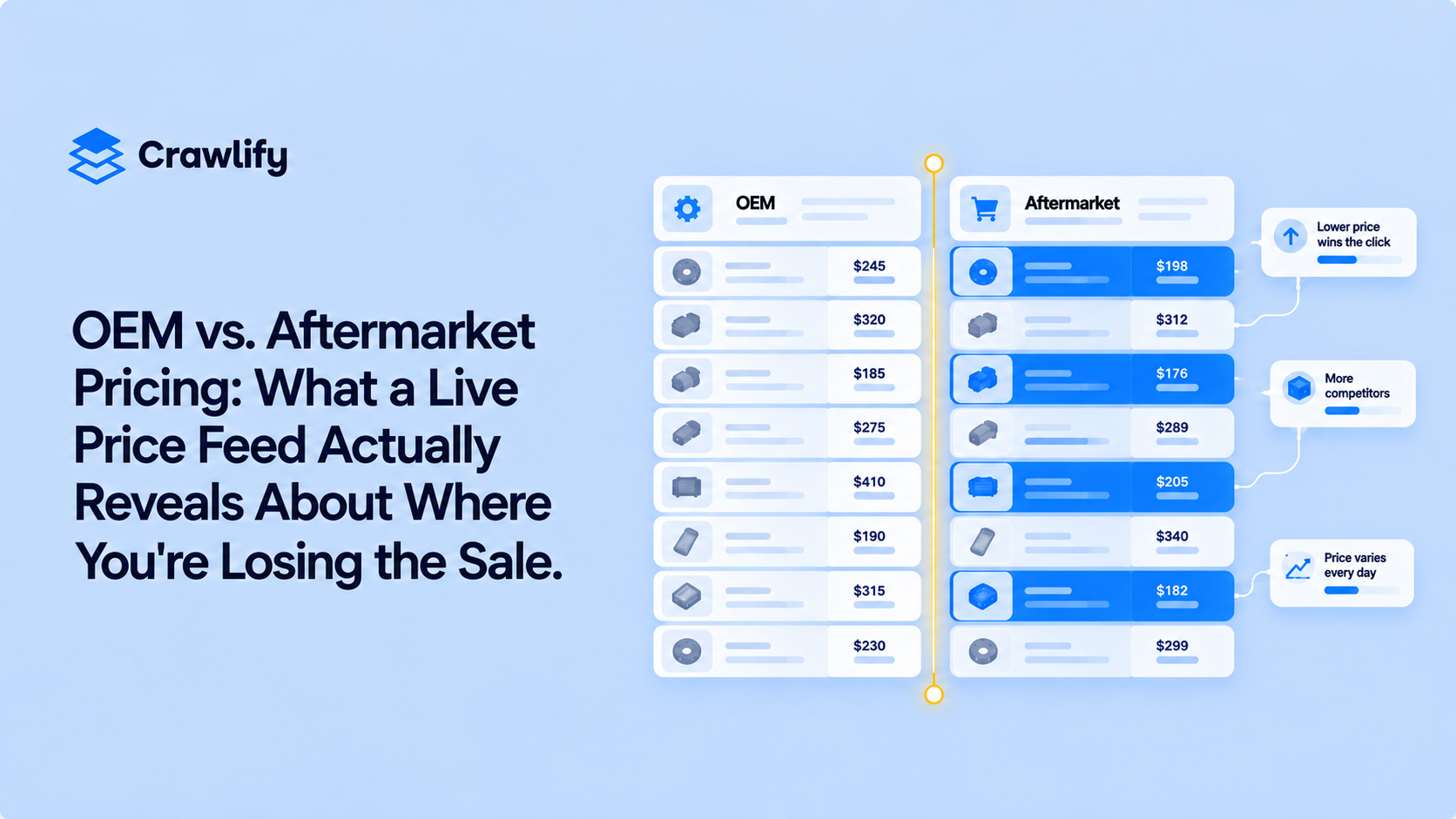
TL;DR — Everyone in automotive already knows OEM parts cost more than aftermarket. The Insurance Information Institute's own trade data puts OEM body parts at roughly 50% above aftermarket equivalents, and aftermarket already accounts for something like half of what independent repair shops buy. In May 2026, PartsTrader's own parts-price index reported OEM prices still climbing while aftermarket prices held flat — the gap isn't closing, it's compounding. None of that industry-wide framing tells a parts seller, distributor, or marketplace anything they can act on this week. The number that matters isn't the average gap across the category. It's which of your SKUs, on which of your channels, sits mispriced right now — and that requires a live feed at SKU and channel granularity, not another market-size stat.
The gap everyone already cites
Ask anyone who has bought a bumper cover, a headlamp assembly, or a brake rotor whether OEM or aftermarket costs more, and they'll answer without checking a source. They're right to. The gap is real, it's well documented, and it isn't going away.
The clearest published figure comes from the America Property Casualty Insurers Association, cited in Edmunds' own buying guide: OEM parts tend to cost about 50% more than aftermarket alternatives for bodywork. That's not a fringe estimate — it's the number insurers themselves use when modeling collision-repair cost, because it's the number that determines whether a claim gets steered toward OEM or aftermarket parts in the first place.
The volume side of the story is just as settled. A 2022 AutomotiveResearch.com study of 500 independent repair shops, also cited via Edmunds, found aftermarket parts already accounted for roughly 50% of total parts purchases at those shops, with more than 30% of shops reporting they'd increased aftermarket purchasing over the prior two years. Read plainly: half the parts moving through independent repair already skip OEM entirely, and the trend line was pointing further that direction even before the tariff and inflation pressure of the last two years.
And the gap isn't static. In May 2026, Repairer Driven News reported on PartsTrader's own collision-parts price index, with a headline finding that's about as direct as trade reporting gets: OEM parts prices increasing, while aftermarket prices remained flat. Whatever the exact spread was a year ago, it's wider now.
None of this is controversial, and none of it is new information to anyone reading a piece with this headline. Which is exactly the problem with stopping here.
The number that matters isn't industry-wide
A 50% average gap, or a "flat vs. rising" trend line, tells you something true about the category. It tells you nothing about the part number in front of you right now.
Averages hide as much as they reveal. A 50% OEM premium on collision body panels says nothing about what the premium looks like on a water pump, a sensor, or a wear item where aftermarket brands compete on quality as much as price. A national trend toward flat aftermarket pricing says nothing about what a specific competitor did to their price on a specific SKU last Tuesday, in the specific channel where your buyer is shopping.
This is the same failure mode that shows up in every pricing category once you look closely: the industry-wide number is true and useless at the same time, because the decision that actually loses or wins a sale happens at the SKU level, not the category level. A buyer comparing water pumps for a 2019 F-150 doesn't care what the average OEM-vs-aftermarket gap looks like across the whole industry. They care what three or four sellers are charging for that exact part, today, on the channel they're looking at.
If your pricing strategy is built on "OEM generally costs about 50% more, so we'll price accordingly," you're pricing to an average that no individual customer ever actually compares against.
Same part number, different price, different channel
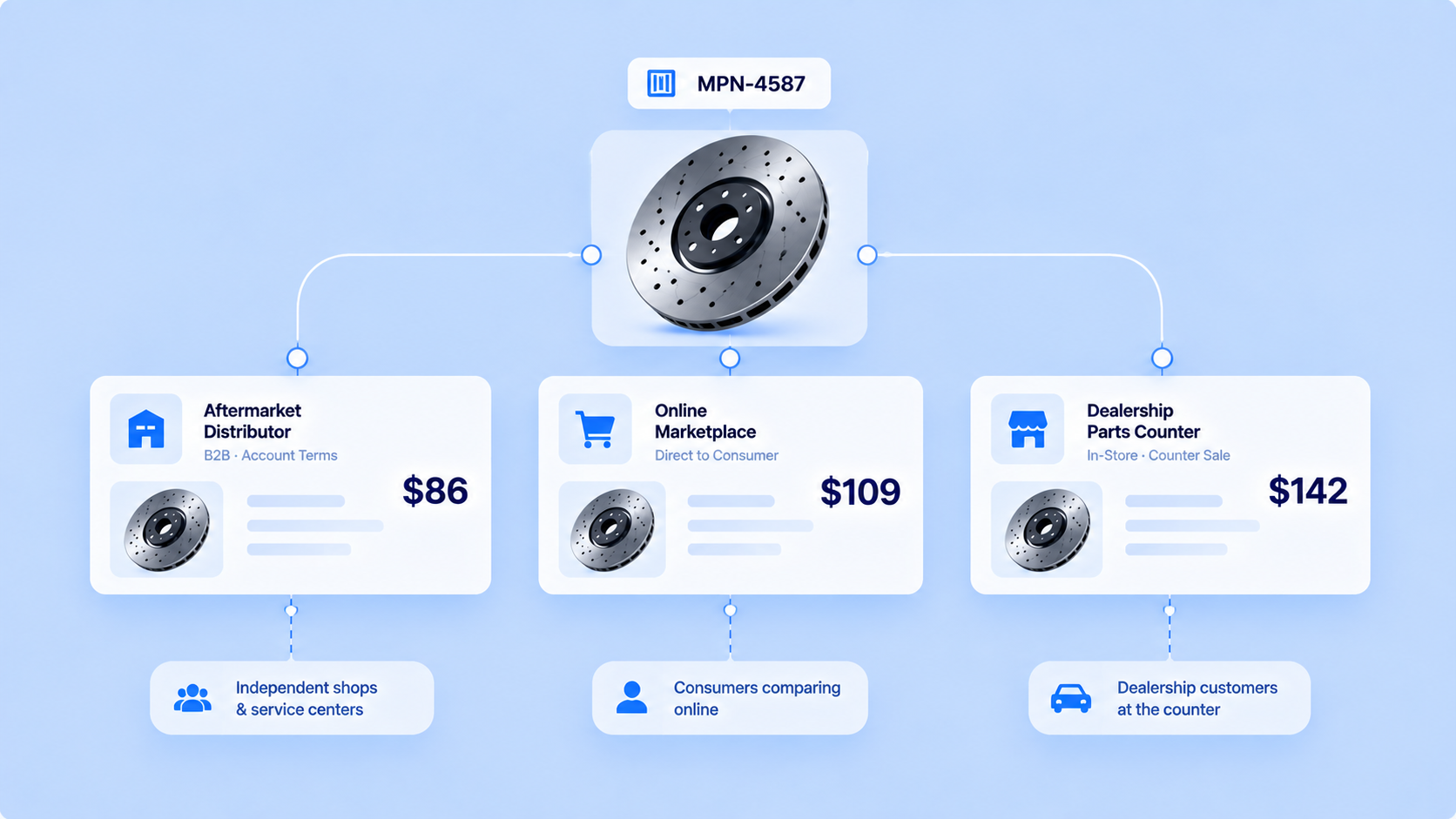
Here's where the picture gets genuinely useful instead of merely well-documented: the same physical part, under the same manufacturer part number, doesn't have one aftermarket price. It has as many prices as there are channels selling it.
A brake rotor can be priced one way through a traditional aftermarket distributor selling into independent shops on account terms, priced differently on a direct-to-consumer marketplace listing competing on delivered price and reviews, and priced a third way through a dealership parts counter that's barely aware the aftermarket price exists at all. Three channels, one part number, three prices — and in most operations, nobody owns the job of watching all three at once, because pricing, marketplace management, and dealer-network relations usually sit in three different teams with three different systems.
That fragmentation is exactly where sales get lost without anyone noticing. A part priced correctly against traditional aftermarket competitors can still be losing every marketplace comparison because marketplace-channel pricing moves on a different clock — sometimes daily, driven by algorithmic repricing tools the seller on the other end is running and you aren't. By the time a monthly or quarterly review catches that gap, it's been open for weeks, and every buyer who compared during that window bought from someone else.
This is the "SKU by SKU, channel by channel" problem in practice. It isn't a bigger version of the industry-wide gap. It's a different question entirely, and it's the one an OEM, distributor, or marketplace seller actually needs answered.
Fitment chaos is where the gap hides
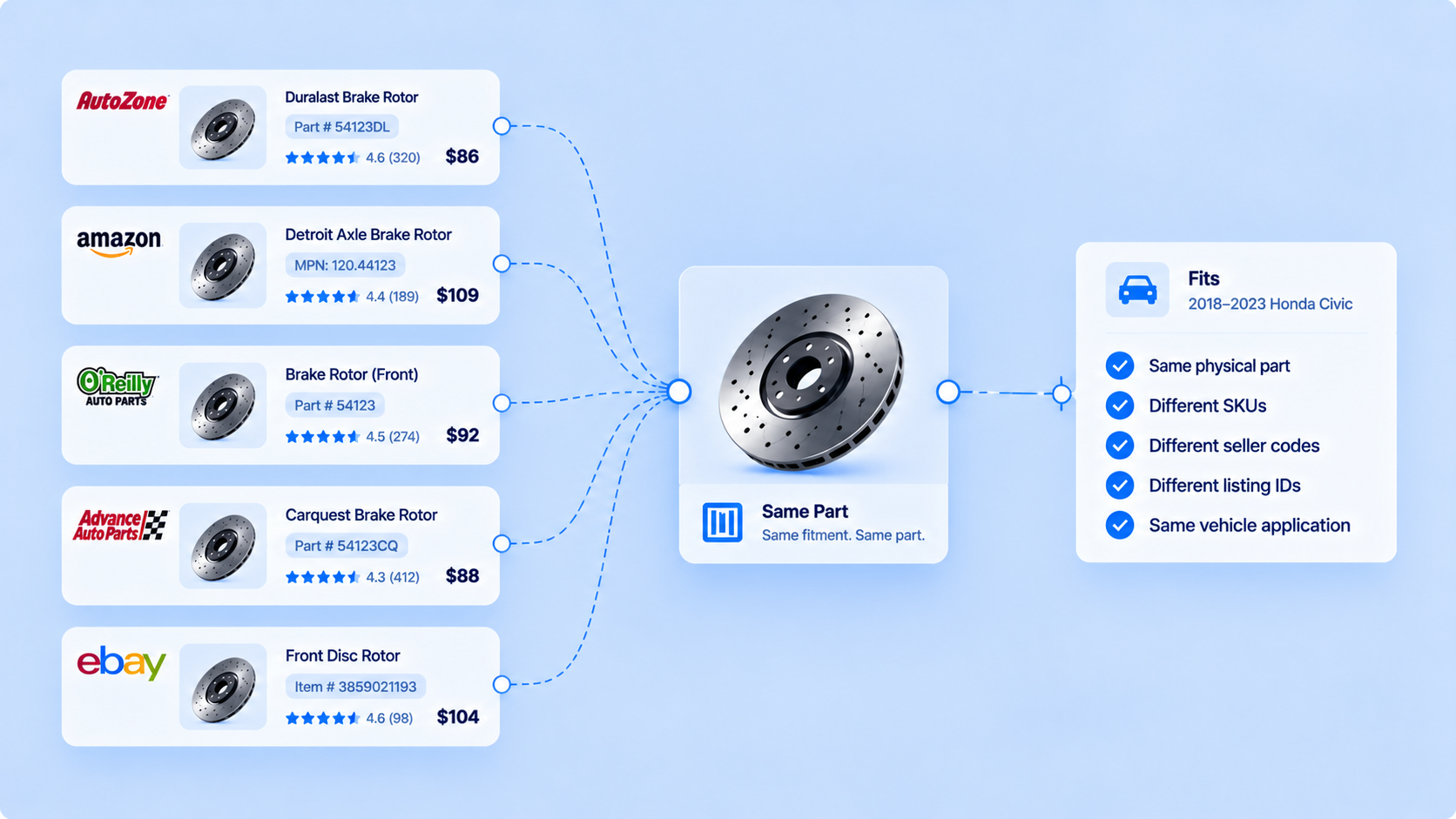
There's a second layer that makes this harder than it sounds, and it's specific to automotive in a way most other pricing categories don't deal with: fitment.
The same physical part routinely ships under different SKUs from different sellers — a different manufacturer code, a different distributor part number, a different marketplace listing ID — all describing the identical component for the identical vehicle application. That's a known, chronic operational headache across the aftermarket, not a hypothetical. It means a straightforward question like "what is this part actually selling for across the market" isn't a single lookup. It's a matching problem first, and a pricing problem second.
Get the matching wrong and the pricing conclusion is wrong in a way that's worse than having no data at all — you can end up confidently comparing your price against a part that only looks like a match, and repricing against a phantom competitor. This is the reason a lot of "just scrape competitor prices" projects in this vertical stall out: the extraction is the easy 20%. Normalizing fitment across sellers who all describe the same part differently is the hard 80%, and it's the part that determines whether the resulting price comparison means anything.
What "live" has to mean for parts pricing data
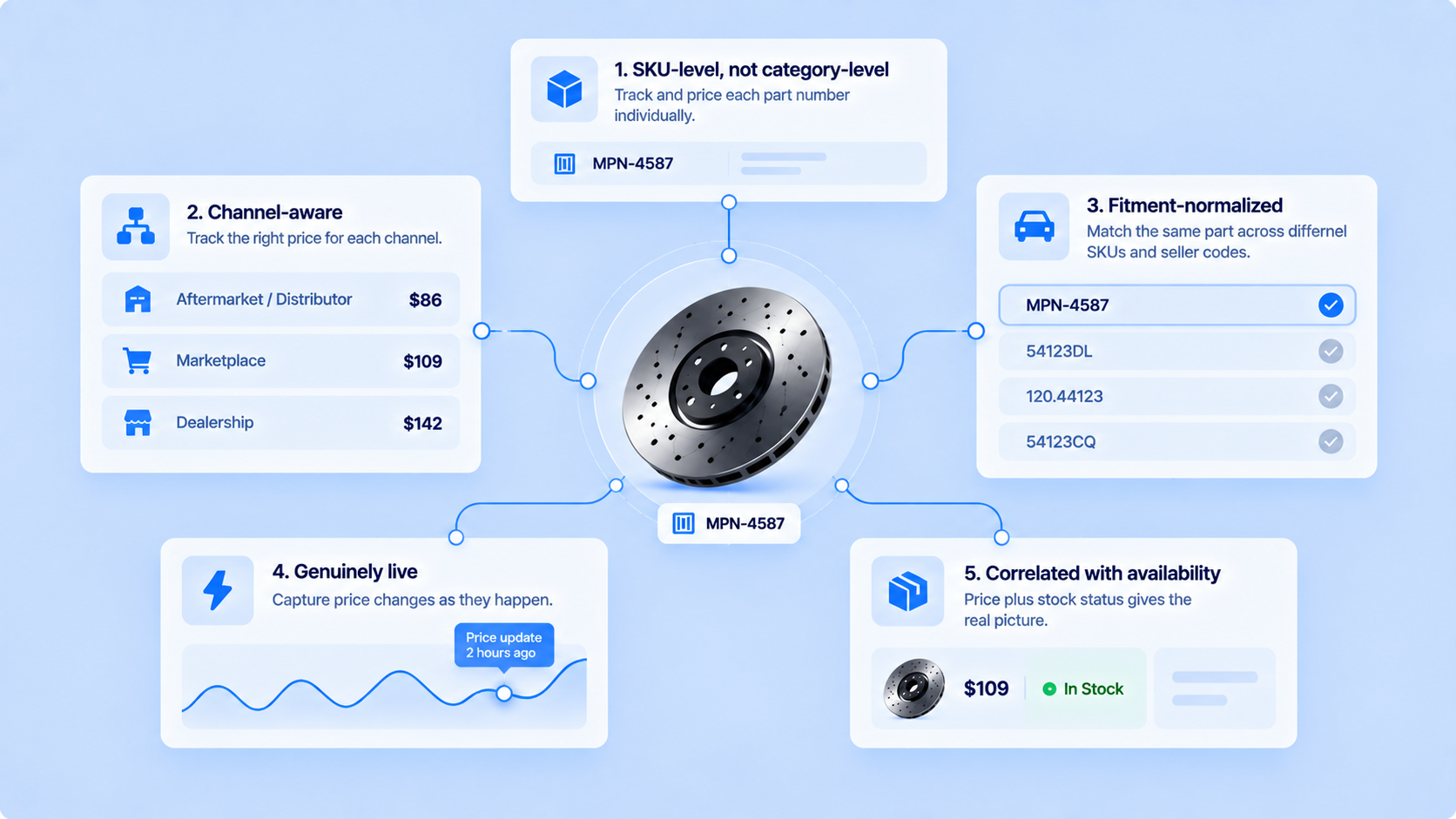
Put the last three sections together and the requirements for a usable automotive pricing solution get specific fast:
- SKU-level, not category-level. A dashboard that reports "aftermarket is running X% below OEM this quarter" is a market report, not a pricing tool. The output that matters is priced by part number.
- Channel-aware. The same part number needs its own tracked price per channel — traditional aftermarket distribution, marketplace, dealership — because the competitive set and the pricing cadence are different in each one.
- Fitment-normalized. Price data is only as trustworthy as the matching underneath it. A price comparison across mismatched parts isn't an incomplete answer, it's a wrong one presented with false confidence.
- Genuinely live. Marketplace pricing in particular can move daily. A pricing feed refreshed monthly is describing a market that no longer exists by the time anyone reads the report.
- Correlated with availability. A competitor's low price on a part they're out of stock on isn't a threat you need to match. The same price on a part they just restocked is. Price without stock status produces a confident wrong conclusion, not just an incomplete one — the same failure mode that shows up whenever price data gets treated as a standalone signal instead of one input among several.
Most tools in this space do one or two of those five well. Doing all five together — at automotive's SKU volume, across automotive's channel fragmentation, with automotive's fitment complexity layered on top — is a different order of problem than tracking prices on a few hundred retail SKUs.
Turning the gap into a signal you can act on
This is what Crawlify was built to do for exactly this kind of problem: not to tell you that OEM costs more than aftermarket, which you already knew, but to tell you which of your own part numbers, on which of your channels, is mispriced against the market right now.
The approach runs on four verbs — Monitor → Detect → Correlate → Act — and the reason "correlate" is its own step rather than an afterthought is the same one covered above: a price feed without a stock feed produces wrong conclusions, not just wrong values. Crawlify pairs price data with availability, channel, and fitment context, so a repricing alert means something instead of triggering a race-to-the-bottom against a part nobody can actually buy.
Every data point carries a 99.5% verified field-level accuracy guarantee, with a verifier ID and timestamp attached to each record — because in a category where the wrong part-to-part match silently corrupts every comparison downstream of it, "we scraped some numbers" isn't a credible starting point for a pricing decision. And because most teams evaluating this kind of tool have already sat through a six-month integration pitch from someone else, the standard here is being live in days, not months.
If you're a parts manufacturer trying to see where your own distributor network is losing ground to marketplace sellers, a distributor trying to hold margin against a fragmented aftermarket, or a marketplace seller trying to catch a competitor's daily repricing before it costs you the next ten sales — this is the specific gap Crawlify is built to close.
See your own OEM-vs-aftermarket gap
You can get a rough sense of your own exposure without any tooling at all. Pick twenty part numbers you sell across more than one channel, check today's price for each one on every channel a buyer could reasonably compare against, and note how many of those twenty are priced differently than you assumed. Most teams doing this for the first time find the surprises cluster in the channel they check least often — usually marketplace, because it moves the fastest and gets reviewed the least.
See your own gap. Send us your part number list and the channels you sell through, and we'll return a one-page map of where OEM and aftermarket pricing actually diverge today, SKU by SKU — no pitch attached, just the map, and what it would take to keep it current. crawlify.ai/pilot · hello@crawlify.ai.
Frequently Asked Questions
