
By Varun Patel, Founder & CEO of Crawlify | Sep 29, 2026 | 8 min read
Journal Web Identity Drift: What We Found Auditing 100 India-Assigned Journals
94 of 100 India-assigned journals were identifiable online — but 30 of 100 had a public-metadata address that no longer led to the journal, and 9 of 97 had a domain with a materially changed identity. Here's what a 100-journal audit found, with evidence for every finding.
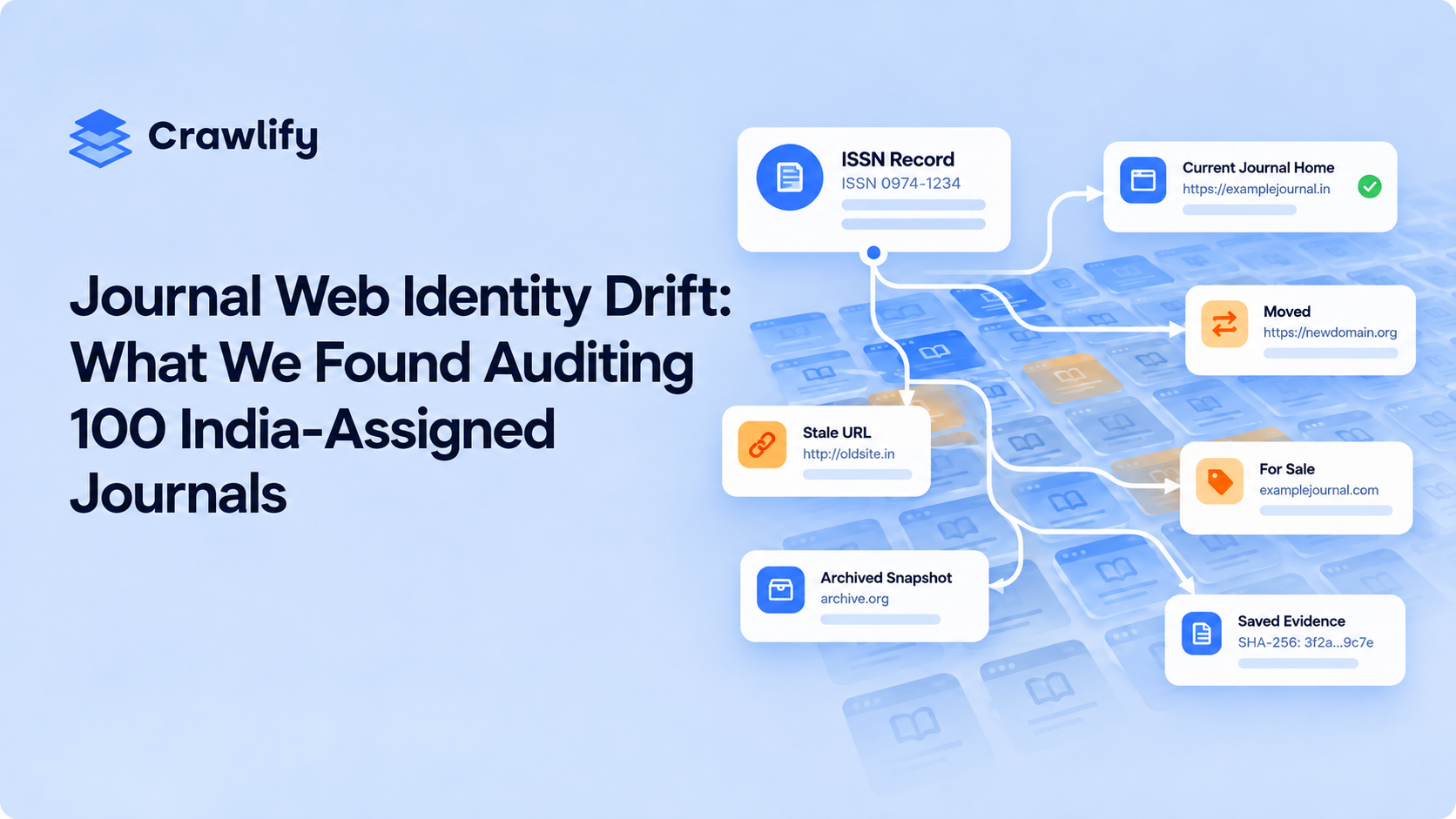
TL;DR — An ISSN can stay with a journal for decades; the web addresses, publishers and indexing claims tied to it can drift much faster. We audited 100 India-assigned journals against the ISSN Portal, OpenAlex, DOAJ, Scopus and the Wayback Machine (observations 24–28 September 2026). 94 of 100 journals were identifiable online, but 30 of 100 had at least one public-metadata address that no longer led to the journal, and 32 of 100 had moved to a different web location — 31 of those 32 moves were legitimate migrations, so a move by itself isn't the problem. 9 of 97 journals with archived web history had a journal-associated domain with a materially changed identity, including 6 of 97 with a former domain now serving (or that had served) gambling, adult or other unrelated content. On indexing, 1 of 17 explicit Scopus claims and 2 of 26 explicit DOAJ claims no longer matched the authoritative record. Every number here is scoped to this 100-journal sample and backed by a saved snapshot, timestamp, screenshot and SHA-256 hash — it's the dataset Crawlify's Journal Web & Metadata Monitoring service is built on.
Why we looked
When a journal has an ISSN, public metadata sources such as the ISSN Portal, OpenAlex and DOAJ may carry web addresses that help readers, librarians, indexers and other systems locate it.
Keeping those addresses continuously aligned with the live web is difficult. Domains expire, journal sites move to new publishing systems, publisher infrastructure changes, and indexing status can change while older claims remain visible on a journal website.
We wanted to know how often that kind of drift was visible in a defined sample, using evidence that we could re-check against live pages, authoritative sources and archived snapshots.
The numbers
Every figure below keeps its own denominator: the number of journals for which that particular measure could actually be checked.
Finding the journal
- 94 of 100 journals were identifiable online at the time of review, and a current home was established for 93 of 100.
- 30 of 100 journals had at least one journal or homepage address in ISSN Portal, OpenAlex or DOAJ that no longer led appropriately to the journal. Preservation-network links and other non-homepage resource links were excluded from this count.
- 32 of 100 journals had moved to a different web location. 31 of those 32 moves were legitimate migrations: a redirect, a publisher platform move, or a new home that could be independently linked to the same journal.
Journal-associated domains
- 9 of 97 journals with an archived web history had a journal-associated domain with a materially changed web identity:
- 6 of 97 had a former journal-associated domain that now served, or before going dark had served, gambling, adult or other unrelated content. Historical Wayback captures showed those domains serving the journal earlier.
- 1 of 97 had a former journal domain, still listed in the ISSN Portal, that was offered for sale.
- 2 of 97 shared a publisher domain that returned slot-gambling content to crawler-style requests while an ordinary desktop-browser request returned the publisher's own site.
These findings concern the web addresses and domains, not the journals' editorial conduct or the intent of publishers or domain owners.
Indexing claims
- 16 of 17 explicit Scopus claims were supported by the August 2026 Scopus Source List. The remaining journal presented a current Scopus ranking on its homepage while the Source List recorded the title as discontinued, with coverage ending in 2025.
- 24 of 26 explicit DOAJ claims were supported by a current DOAJ record. For the other 2 of 26, the DOAJ API returned no journal record for any of the journal's ISSNs at the time of review.
Registered metadata
| Field | Confirmed change | Journals where it could be compared |
|---|---|---|
| Publication frequency | 3 | 52 |
| Title under the same ISSN | 1 | 94 |
| Named publisher | 1 | 51 |
| ISSN shown for the wrong medium, or someone else's ISSN | 0 | 100 |
Which recorded addresses still lead to the journal?
For this comparison, we counted only journal/homepage addresses. Preservation-network links such as CLOCKSS, LOCKSS, Portico and similar non-homepage resource links were excluded.
At journal level, an address source was counted as leads to the journal if at least one of its recorded homepage addresses led directly to the journal, redirected legitimately, or reached the journal on a publishing platform. It was counted as does not lead when homepage addresses were present but none led to the journal and at least one was confirmed stale, dead, unreachable, parked, for sale, server-default, hosting-error, repurposed or unrelated. Unknown or absent homepage addresses were not included in the checkable denominator.
| Recorded address source | Leads to the journal | Does not lead to the journal | Not observable / no usable homepage | Checkable denominator |
|---|---|---|---|---|
| ISSN Portal | 66 | 24 | 10 | 90 |
| OpenAlex | 70 | 21 | 9 | 91 |
| DOAJ | 47 | 2 | 51 | 49 |
Among the checkable homepage addresses in this sample, 24 of 90 ISSN Portal records, 21 of 91 OpenAlex records and 2 of 49 DOAJ records did not currently lead appropriately to the journal.
"Does not lead to the journal" covers several different states: an obsolete page on a still-live publisher site, a server that no longer answers, a domain with no DNS record, a hosting-error or default-server page, a parked or for-sale domain, or unrelated content. Most cases were ordinary link or infrastructure staleness. A smaller set involved a more substantial change in what the former address or domain now served.
What drift looks like
These examples come from confirmed findings. The journals are not named here; the evidence records are retained with the research dataset.
- Former domain. A social-science journal's old domain, which served the journal in 2018, now hosts an online betting game. The journal continues at a different domain on the same publisher's publishing system, while the former address remains in OpenAlex.
- Hidden root. A management journal's ISSN Portal path now returns "page not found." Looking one level up showed that the domain root had appeared as a registrar parking page in 2025 and later carried a Chinese lottery title. Checking only the recorded path would miss the domain-level change.
- For sale. An ophthalmology journal's domain, which served the journal from 2011, now displays a domain-sale page. The address remains in the ISSN Portal, while the journal now publishes on a major publisher's site.
- Crawler-only. A publisher domain returned an Indonesian slot-gambling page to crawler-style requests, while a normal desktop-browser request returned the publisher's own website. The journal itself remained live on the publisher's OJS subdomain.
- Indexing. A signal-processing journal's homepage stated that its CiteScore "is now 11.6, ranking it in Q1 on Scopus." The August 2026 Scopus Source List recorded the title as inactive/discontinued, with coverage ending in 2025.
- Indexing. An engineering journal stated that more than 3,100 of its published articles were indexed in DOAJ. The DOAJ API returned no current journal record for its ISSN at the time of review.
- Legitimate move. A physiotherapy journal moved from its former domain to a new one and clearly announced the move on the old site. This is what a clean migration looks like. 31 of the 32 moves in the sample were classified as legitimate migrations.
What this does and doesn't tell you
The numbers describe these 100 sampled journals. They are not an estimate for all Indian or all India-assigned journals. The sample came from OpenAlex journals with an ISSN, more than 50 works and a homepage, and was built in 2 seeded batches split between DOAJ-listed and other journals.
- A former domain that now serves gambling or other unrelated content means the domain's use changed. It does not mean the journal itself is compromised, and it says nothing about the intent of the journal, its publisher or a domain owner.
- Nothing in this study measures peer-review quality, editorial quality, journal legitimacy or research quality.
- Only Scopus and DOAJ claims were checked against the index itself for the headline claim analysis. Claims involving Web of Science and other services were recorded where observed but were not judged unless an authoritative verification source was available within the study.
- Editorial-board change was treated as descriptive background, not an integrity signal. Across 56 journals where a historical and current board could be compared, median annualised turnover was 9.4%.
- The study measures observable web and metadata drift in this sample. It does not establish why a domain changed, why metadata became stale, or who was responsible for a particular change.
How we did it
- Sample. 100 journals drawn in 2 seeded batches of 50 from OpenAlex. Each journal had ISSNs assigned by the ISSN India centre and present in the public ISSN India register. No journal was dropped or replaced because its website was dead, moved, blocked or difficult to inspect.
- Baselines. We used the public ISSN India register for fields such as title, place, start year, frequency and medium, together with archived Wayback captures of journal-associated web addresses.
- Current state. We fetched addresses associated with the journal through ISSN Portal, OpenAlex and DOAJ, inspected relevant domain roots, followed redirects, and retained raw snapshots, timestamps, screenshots and SHA-256 hashes.
- Indexing. Explicit Scopus and DOAJ claims made on journal pages were checked against the August 2026 Elsevier Scopus Source List and the DOAJ API.
- Review. Automation collected evidence and proposed candidate findings. Every one of the 100 journals then went through a structured review under a written protocol with AI assistance, whether or not the automated stage had flagged anything. A headline finding was counted only when the review confirmed it against retained evidence.
- Address statistics. Homepage/address counts exclude preservation-service links and other resources that were never intended to function as journal homepages.
Why continuous monitoring
Many of the web-identity changes in this sample were not visible from the journal's current homepage alone. They appeared only when we followed addresses still held by other metadata systems, inspected a domain root when a recorded path failed, compared current content with archived snapshots, or checked a current indexing claim against the index itself.
That suggests a useful role for periodic monitoring: detect the change, preserve the evidence, verify the signal, and hand the result to a person for review. This dataset is what our own Journal Web & Metadata Monitoring service is built on — the same detect, verify and preserve-evidence pattern, run on a recurring cadence against a customer's own journal list.
Crawlify Research · Journal Web Identity Drift · dataset: 100 journals · observations 24–28 September 2026 · counts use field-specific denominators and describe this sample only.
Want this monitoring for your own journal list? See Journal Web & Metadata Monitoring →
Frequently Asked Questions
