
By Varun Patel, Founder & CEO of Crawlify | Aug 26, 2026 | 13 min read
Exclusivity vs. Accuracy: The Two Things Alt-Data Buyers Actually Pay For
Alt-data exclusivity is decaying. The average dataset now serves 20 funds, down from 25. When everyone has the same feed, provenance is the only moat. Here's what DDQ-ready verification actually looks like.
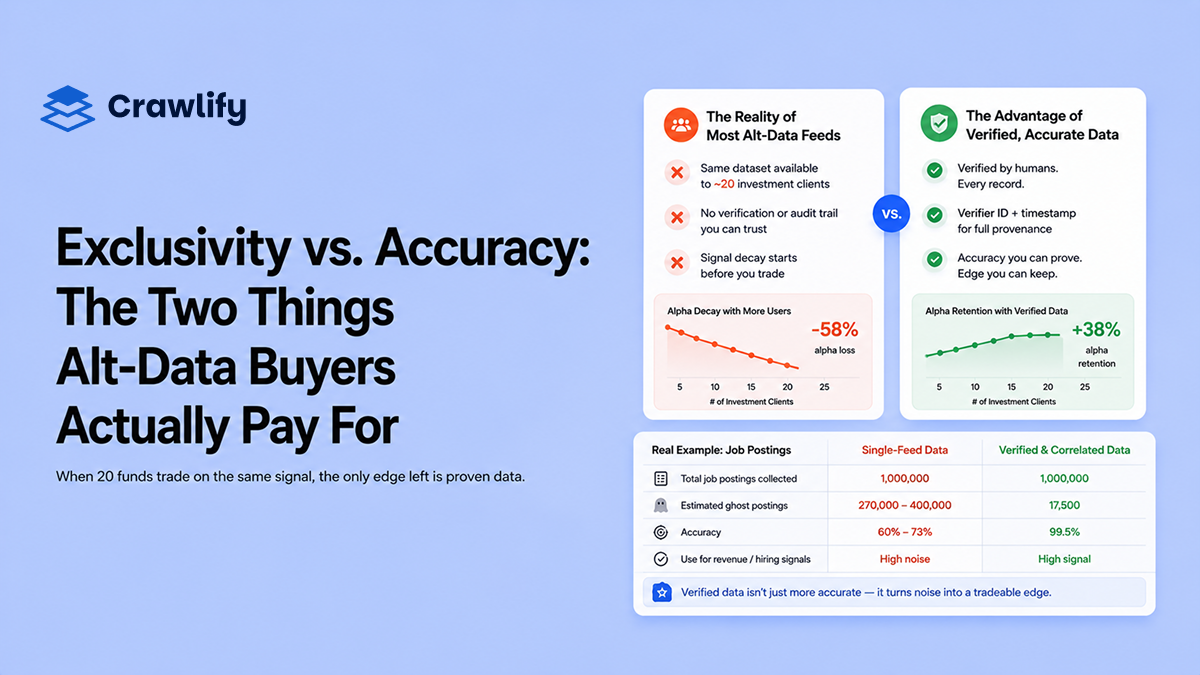
TL;DR — The alt-data market hit $7.8 billion in 2025. Web-scraped data is its fastest-growing segment. And the average dataset now serves 20 investment clients, down from 25 the year before. Exclusivity is decaying by the quarter: when 20 funds trade on the same signal, it's priced in before the trade executes. The only edge left isn't who has the data — it's who can prove the data is right. Provenance — who verified each record, when, and what it was correlated against — is the new moat, and almost nobody selling web-scraped data can produce it in writing.
The market — what buyers actually spend, and where it goes
Finance audiences dismiss anything that doesn't lead with a number, so start with the numbers, and with the caveat that makes them usable.
- The total alt-data market reached $7.8 billion in 2025, projected at $8.7 billion in 2026 and roughly $41.4 billion by 2033 — a 23.4% CAGR. (Grand View Research, report GVR-2-68038-166-3, and Fortune Business Insights estimates.) Neudata separately puts investment-manager alt-data spend at $2.8 billion — a smaller, more specific number. The two aren't in conflict: Neudata measures investment-manager spend only, while Grand View measures the total market, including corporate, government, and non-financial buyers. Cite both, and label the scope each time.
- Web-scraped data is the fastest-growing segment. Social and web data together account for the largest share of the market, above 30%, with investment-manager alt-data spend up 17% year-over-year (Neudata, February 2026).
- The average dataset now serves roughly 20 investment clients, down from 25 the year before. (Neudata, 2026 — the exclusivity-decay stat this whole piece turns on.)
- Over 90% of asset managers plan to increase alt-data budgets, and 92% of hedge funds now use alt-data in some form. (EY Global Alternative Fund Survey 2025; Grand View Research buyer surveys.)
The exclusivity problem: why the same feed to 20 funds kills alpha
This is the first half of the thesis, and it's a structural claim, not a fixable-by-marketing one.
Signal decay is well documented in the academic literature: McLean and Pontiff (Journal of Finance, 2016) and Yan and Zheng (2017) find post-publication alpha decay of 26–58% for published factor strategies. The direct application to alt-data specifically is an inference rather than an empirical result on named datasets, but the mechanism is the same one at work: once a signal reaches somewhere around 15–20 simultaneous users, the trades built on it start showing up in the price before any one fund can capture the edge.
The historical precedent is satellite imagery of retail parking lots — a genuinely novel signal circa 2015–2017 that generated measurable alpha for early adopters. By 2020, adoption had reached critical mass and the signal had decayed to background noise. Web-scraped pricing, job-posting, and sentiment data are now on the same trajectory, just later in the cycle.
Vendor proliferation is accelerating the decay, not slowing it. Neudata's Scout platform now lists 2,805 datasets from 1,865-plus vendors, up from roughly 1,500 vendors in 2023. More vendors selling comparable feeds means more clients per signal, which means faster commoditization — the market is scaling the exact dynamic that erodes the thing buyers are paying for.
The accuracy problem: what "99% accuracy" actually means, and doesn't
This is the second half of the thesis. When exclusivity is structurally unavailable, accuracy — provably, not just claimed — is the only differentiator left standing.
As of a direct competitor-page check in August 2026: Bright Data publishes a 99.9% uptime SLA, which is not an accuracy claim. Apify publishes 99.5% availability. Zyte claims "99.9% accuracy" with no published methodology behind the number. ScrapeHero, PromptCloud, and Grepsr make qualitative accuracy claims without a figure. Actowiz cites a 99% marketing claim. None of them publish a field-level accuracy SLA with per-record verification metadata. Crawlify's 99.5% field-level SLA, backed by a verifier ID and timestamp on every record, remains — as far as public documentation shows — unique in the category.
The distinction matters mechanically, not just rhetorically: a quant team cannot build a backtest on "we're accurate." It needs a verifiable methodology — a stated sampling rate, a remediation clause, and per-record verifier metadata — that a data-quality reviewer can actually evaluate rather than take on faith.
That's precisely what the AIMA DDQ framework asks for. The AIMA Illustrative DDQ for Alt Data explicitly probes data-collection methodology, accuracy validation, and error-correction process. A verifier ID and timestamp per record answers AIMA's Section C — data quality and accuracy — directly. A "99% accurate" marketing line cannot answer it at all, because there's nothing behind the number to inspect.
The DDQ: how compliance drives procurement
The Due Diligence Questionnaire is the actual gatekeeper for enterprise alt-data sales — it runs before the quant team ever sees a backtest.
| DDQ question area | What the buyer evaluates | Crawlify's answer |
|---|---|---|
| Data collection methodology | How is data sourced? Is scraping disclosed? What's the legal basis? | Documented extraction methodology; the Bright Data v. Meta and Bright Data v. X rulings establish the legality of logged-out public-data collection. |
| Accuracy validation | How is accuracy measured and validated? Is there a published number? | 99.5% field-level accuracy SLA, built on stratified sampling and second-line human verification, with a remediation clause on underperformance. |
| Error correction | What happens when errors surface? What's the turnaround, and the root-cause process? | Contractual remediation. Source monitoring detects schema drift in under 6 hours; broken extractors are rebuilt same-day. |
| Data provenance / audit trail | Can each data point be traced back to its source? Who checked it? | Verifier ID and timestamp per record. Source URL stored against every value. A full audit trail from extraction to delivery. |
| Delivery reliability | Is there an SLA on cadence? What happens if a feed is late or incomplete? | A defined delivery schedule per contract, with continuous volumetric-baseline monitoring that flags an incomplete delivery before it ships. |
| Compliance / legal | GDPR, CCPA exposure; scraping legality; consent basis. | Public-data only, no PII scraping, documented compliance basis referencing the Bright Data precedent. |
The correlation layer: from single-feed data to tradeable intelligence
This is where Crawlify's actual differentiation sits — the layer single-feed vendors are structurally unable to offer, because it requires joining data they don't themselves hold.
Price × inventory. A retailer's price drop means either clearance (inventory rising) or a demand surge (inventory falling). A single-feed pricing vendor delivers the price; a correlated feed delivers which of the two it is. Simon-Kucher's 2026 research found B2B firms implementing real-time dynamic pricing see roughly a 6% revenue increase — the kind of gain that depends on getting that distinction right, not just on having the price.
Job postings × hiring velocity. Ghost-inflated job-posting data — the 27–40% noise range covered in the anti-ghosting compliance post — distorts revenue-prediction signals built on posting counts. De-ghosted, verified postings correlated against actual hiring activity produce a materially cleaner signal. Revelio Labs operates in this exact space and does good work in it, but doesn't publish a field-level accuracy SLA.
ESG claims × facility-level data. Corporate ESG commitments, correlated against facility-level emissions, permit filings, and supply-chain disclosures, are what actually exposes greenwashing. RepRisk monitors upward of 225,000 companies on ESG risk signals; no web-scraping vendor currently correlates that against the underlying corporate-website ESG claims those companies make publicly.
Web traffic × transaction data. Scraped traffic and app-usage estimates, correlated against credit-card or receipt data, produce more robust revenue estimates than either feed alone. SimilarWeb plus Earnest Research is the closest existing combination on the market — but it requires the buyer to procure and join two separate vendor relationships. The alternative is a vendor that delivers the correlated feed directly, rather than the two parts for the buyer to assemble.
Evaluating a web-data vendor this fall? Ask one question before the demo starts: what's your field-level accuracy, and who verifies it? Get a verified sample. crawlify.ai/pilot · hello@crawlify.ai.
The vendor landscape: who delivers what
| Vendor | Pricing | Jobs | ESG | Reviews | Correlation | Acc. SLA | Gap |
|---|---|---|---|---|---|---|---|
| Bright Data | Raw | Raw | Limited | Raw | None | Uptime only | Infrastructure only; no verification |
| Revelio Labs | No | Yes | No | Yes | Intra-platform (HR) | No | HR-only; no accuracy SLA |
| Coresignal | No | Yes | No | Yes | None | No | Raw feeds; no QA layer |
| Thinknum | Yes | Yes | No | Yes | Limited | No | Multi-signal, unverified |
| ScrapeHero | Yes | Yes | No | Yes | None | No | Custom data, no SLA |
| Crawlify | Verified | Verified | Verified | Verified | Multi-feed | 99.5% | Full correlation + published SLA |
"Verified" indicates human QA plus a verifier ID attached to each record. A plain checkmark elsewhere in this category indicates a raw or unverified feed.
The Revelio Labs playbook — and what it says about where the market is going
Revelio Labs' own go-to-market is instructive, independent of the accuracy argument. It found its first durable revenue in finance and alt-data — an AWS Marketplace listing reportedly around $85K a year — before expanding into HR and corporate buyers. It built a weekly workforce-trends newsletter that converted alt-data buyers into customers over time, one verifiable stat per edition, rather than trying to close on the first touch. And it built discoverability across AWS Marketplace, BattleFin, and Neudata Scout rather than relying on outbound sales alone.
None of that playbook is about exclusivity. It's entirely about being findable and credible in front of a buyer who is already looking — which is exactly the posture a vendor needs once exclusivity, the thing that used to make a buyer come looking for you specifically, stops being available to sell.
What to ask before you pay for a dataset
The alt-data industry spent a decade selling access. Access is now abundant — 1,865-plus vendors, 2,805 datasets, 92% of hedge funds already buying. Abundance is not a moat; it's the thing that made exclusivity mechanically impossible; the average dataset losing five clients in a single year is that dynamic showing up in the numbers.
What's left to sell is proof. Not "we're 99% accurate" — a sentence with nothing behind it — but a number with a sampling methodology, a remediation clause, and a verifier ID on every record, submitted the same way to every DDQ a buyer's compliance desk runs. That's a fundamentally different product from a raw feed, built from the same underlying data. Exclusivity decays on a schedule nobody controls. Provenance is the only part of the transaction a vendor can actually make durable.
Name the dataset. We'll deliver a verified, DDQ-ready sample — pricing, job postings, ESG, or any web-scraped vertical — in 5 to 7 business days. $2,500 pilot, on your data, no engineering hours on your side. crawlify.ai/pilot · hello@crawlify.ai.
Frequently Asked Questions
