
By Varun Patel, Founder & CEO of Crawlify | Sep 16, 2026 | 8 min read
The Catalog Coverage Gap: AI Shoppers Check Every SKU You Own. Your Team Checks Twenty.
AI shopping agents now compare whatever a shopper asks about, not just your hero SKUs. Here's why catalog coverage, not check speed, is the 2026 competitive pricing problem.
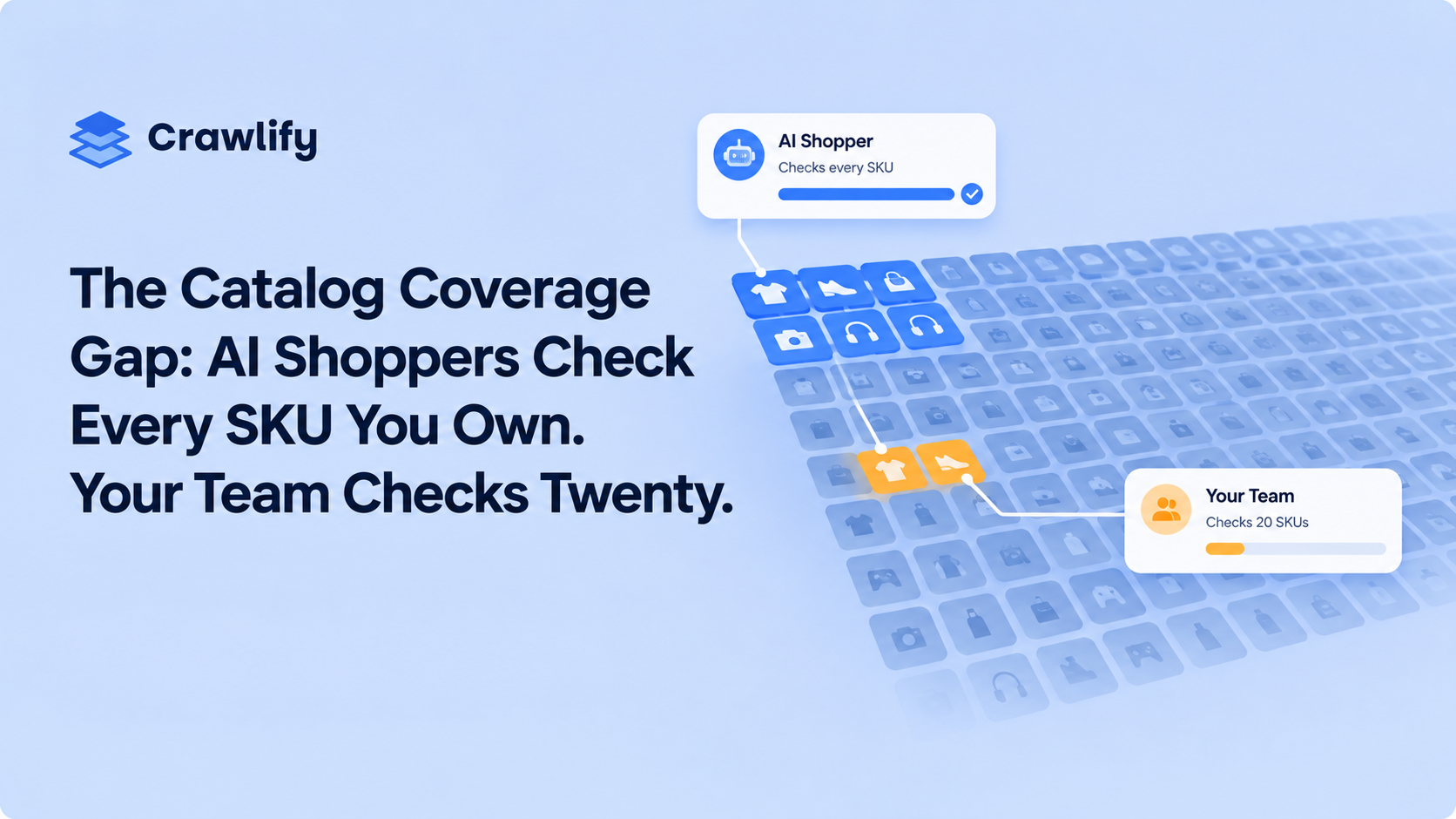
TL;DR — Competitive price monitoring used to be a speed race across a small set of hero SKUs, and that was defensible while the products nobody monitored were also the products nobody compared. Two things broke that assumption this year. Tariff pass-through in 2025 moved competitor prices gradually across eight months rather than in one visible event, which is a pattern a fortnightly spot-check reads as noise. And AI shopping agents, now driving traffic that grew 393% year over year and converts 42% better than paid search, compare whatever the shopper asks about — including the long-tail SKUs your team has never price-checked. The unwatched part of your catalog is now the part most likely to be compared by a machine. Coverage, not cadence, is the 2026 problem.
The question that changed this year
For most of the last decade, competitive price monitoring was a speed problem. Everyone accepted that you watched your important SKUs and let the rest drift, and the arms race was about checking those important SKUs faster than the competition checked theirs.
In 2026 the shape of the problem changed. It isn't mainly about speed anymore. It's about coverage, because the entity doing comparison shopping on your catalog is increasingly not a person with ten browser tabs open. It's software, it works through your whole assortment on demand, and it does not care which twenty SKUs your pricing team decided were worth watching this quarter.
Price became the deciding factor, and retailers know it
Start with the demand side, because it sets up everything after it.
Retail Systems Research surveyed 97 retailers between October and December 2025 and found that 53% named increasing consumer price sensitivity as their top external in-store challenge, ahead of every other pressure they were asked about. Shoppers themselves expect prices to keep climbing: University of Michigan data from April 2026 put consumer expectations at a 4.8% rise over the following year.
That pressure isn't evenly distributed across households, which makes it harder to model, not easier. Wage growth in March ran at 5.6% year over year for higher-income households against 1.0% and 2.0% for lower and middle-income groups, the widest gap since 2015. The shopper trading down on your category is not the same shopper who stopped comparing.
Tariffs didn't move prices once. They moved them for eight months.
Here's the part most pricing teams underestimated, and it's the strongest argument against spot-checking that exists in the public data.
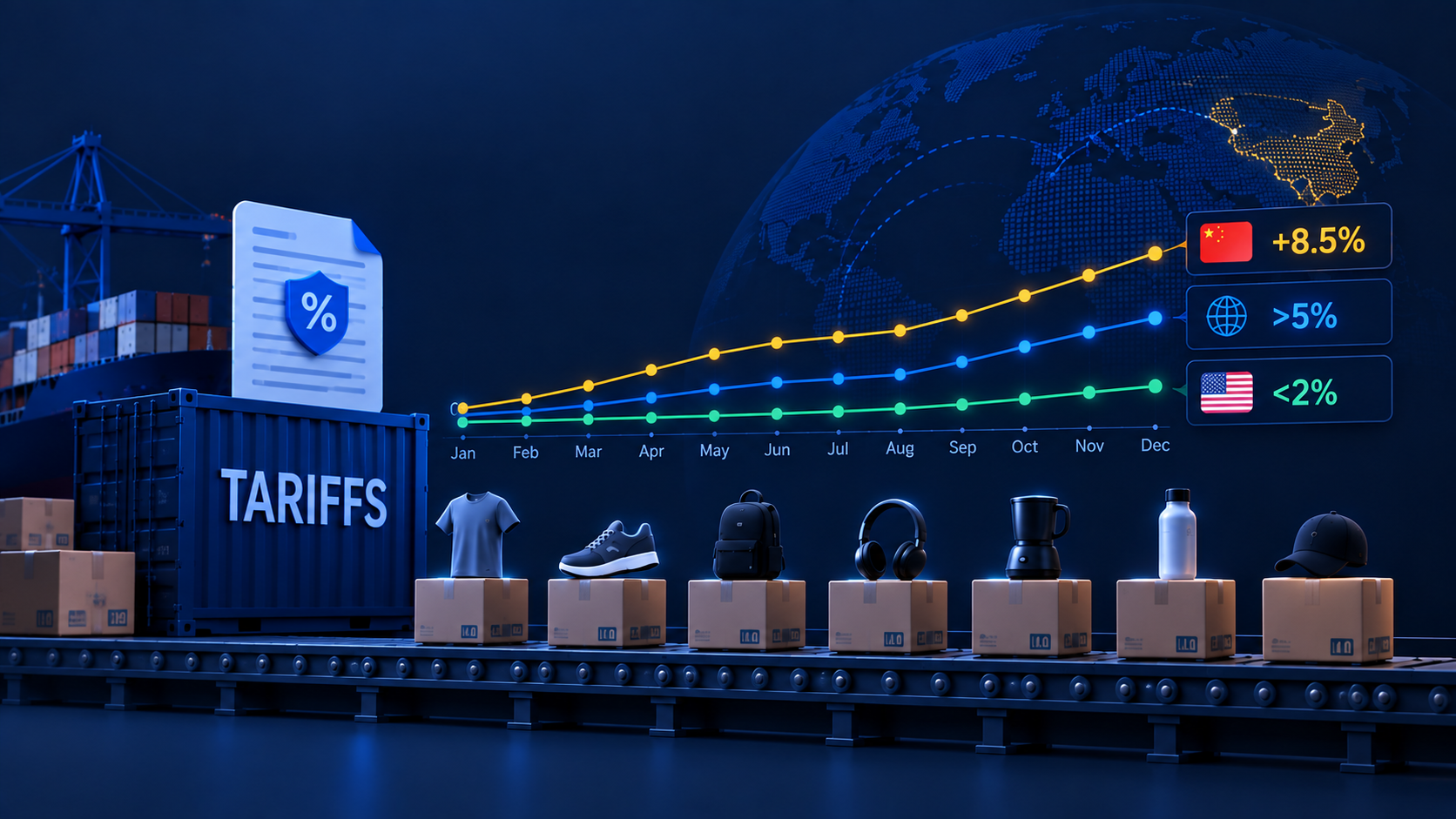
The Federal Reserve published a FEDS Note in March 2026 analysing how 2025 tariffs actually reached retail shelves. The headline finding is the timing: "price pressures developed gradually in 2025 rather than showing up as a one-time price spike." Year-over-year inflation on imported goods sat near zero until April. Meaningful effects on Chinese-origin goods only appeared from August. By December, prices on goods from China were up 8.5% year over year, goods from other countries had climbed past 5%, and US-made products stayed under 2%. Total estimated pass-through to consumers: 28% to 32% of the tariff increase.
Read that as a monitoring problem rather than an economics one. Your competitors did not reprice on a single announced date you could put in a calendar. They absorbed cost for a while, worked down pre-tariff inventory at different rates, and then released price increases at different times, on different subsets of their assortment, depending on where each product was made. The Fed's authors attribute the delay to exactly this: consumer price sensitivity, uncertainty over whether tariffs would stick, and excess pre-tariff stock.
A competitor's catalog migrating upward unevenly over eight months is invisible to a quarterly review and nearly invisible to a fortnightly one. The individual moves are small. The cumulative position change is not.
The margin damage showed up in public filings. e.l.f. Beauty reported gross margin down 30 basis points year over year, attributed largely to tariffs and partly offset by pricing. Under Armour reported a 310 basis point decline, primarily from higher tariffs. Best Buy, by contrast, held average selling prices "essentially pretty flat." Same macro shock, very different price positions at the end of it.
Your newest comparison shopper is a machine
Now the supply side of attention, which is where 2026 genuinely breaks from 2024.
Adobe's Digital Insights team has been tracking traffic arriving at US retail sites from AI assistants. The growth is not incremental:
- 393% year-over-year growth in AI-sourced traffic to US retail sites in Q1 2026
- 693% year-over-year growth over the Nov–Dec 2025 holiday period
- AI-referred visits converted 42% better than non-AI sources such as paid search and email in March 2026
On the consumer side, eMarketer reports 38% of shoppers already use AI in some part of the shopping process, with 80% expecting to use it more, and the dominant use case is comparing options. Roughly 89% still verify what the assistant tells them before buying, which matters: the agent isn't replacing the decision, it's assembling the shortlist that the decision gets made from.
If you sell anything where a shopper could plausibly ask "which of these is cheapest and can arrive by Thursday," you now have a comparison channel that grew fourfold in a year and converts better than the channels you're already paying for.
AI agents don't respect your monitoring priorities
This is the point the older framing of this problem missed entirely.
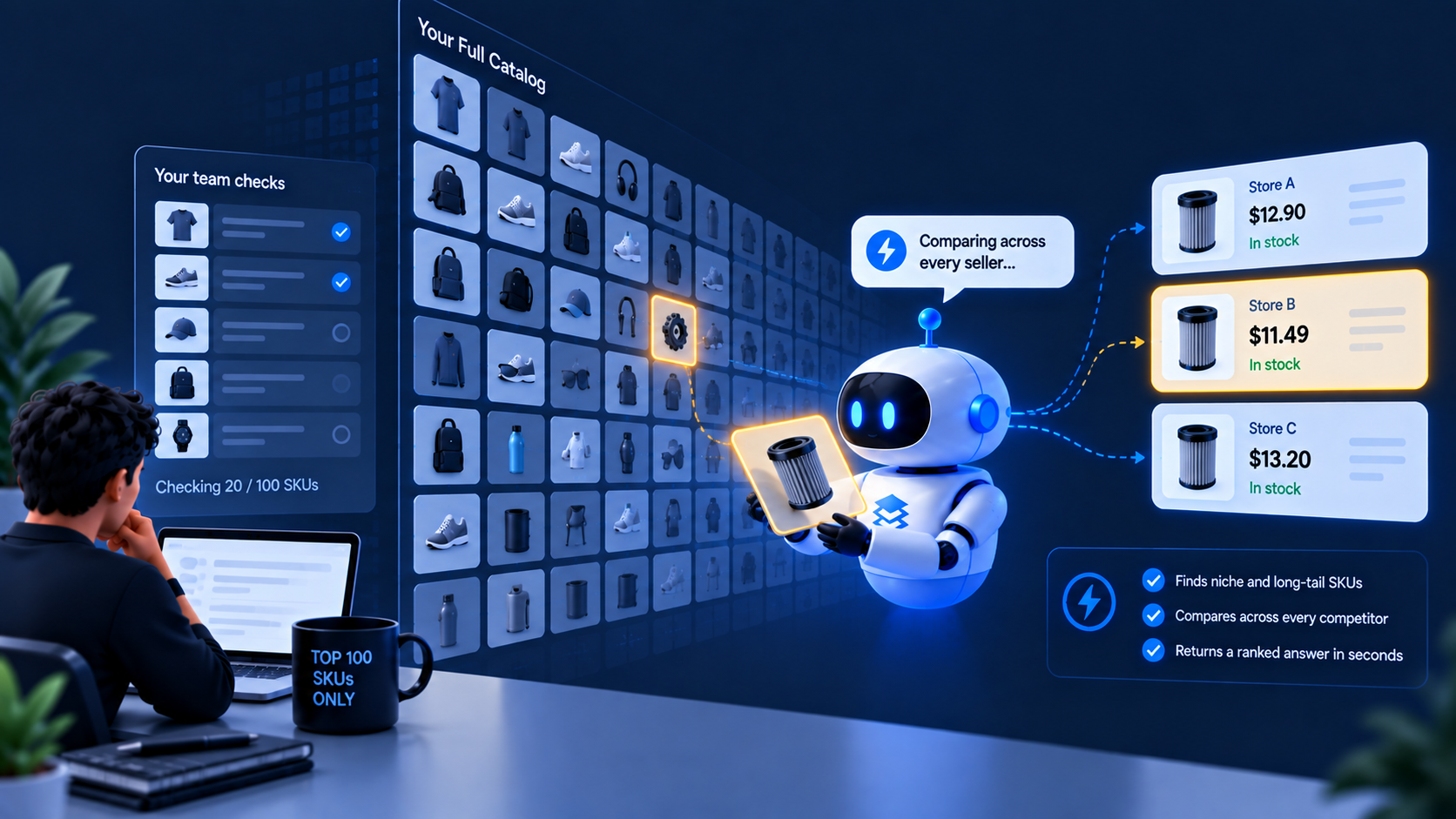
A human comparison shopper behaves predictably. They compare the obvious things: hero products, high-consideration purchases, whatever the category page surfaces first. That behaviour is what made "monitor the top 100 SKUs" a defensible strategy for years. The unwatched long tail was also, mostly, the uncompared long tail.
An AI agent has no such bias. It compares whatever it was asked about. A shopper asking for a specific replacement part, an unusual size, a niche variant, or a substitute for something out of stock sends the agent straight into the part of your catalog nobody on your team has price-checked since it was listed. The agent will compare that SKU against every competitor carrying it, in one pass, in seconds — and the shopper sees a ranked answer, not a search results page.
Adobe's own data suggests most retailers aren't ready for this on either side of the equation. Its AI Content Visibility Checker scored retail product pages at just 66% machine-readable, the weakest of any page type, with the observation that "retailers have thousands of SKUs, and much of the content is currently invisible to LLMs."
So the same long tail is simultaneously the part of the catalog you're least likely to be monitoring, the part an AI agent is most likely to surface on a specific query, and the part least well presented when it does. That's not three problems. It's one problem seen from three angles.
What coverage has to mean now
Four conditions, and skipping any one of them just relocates the blind spot:
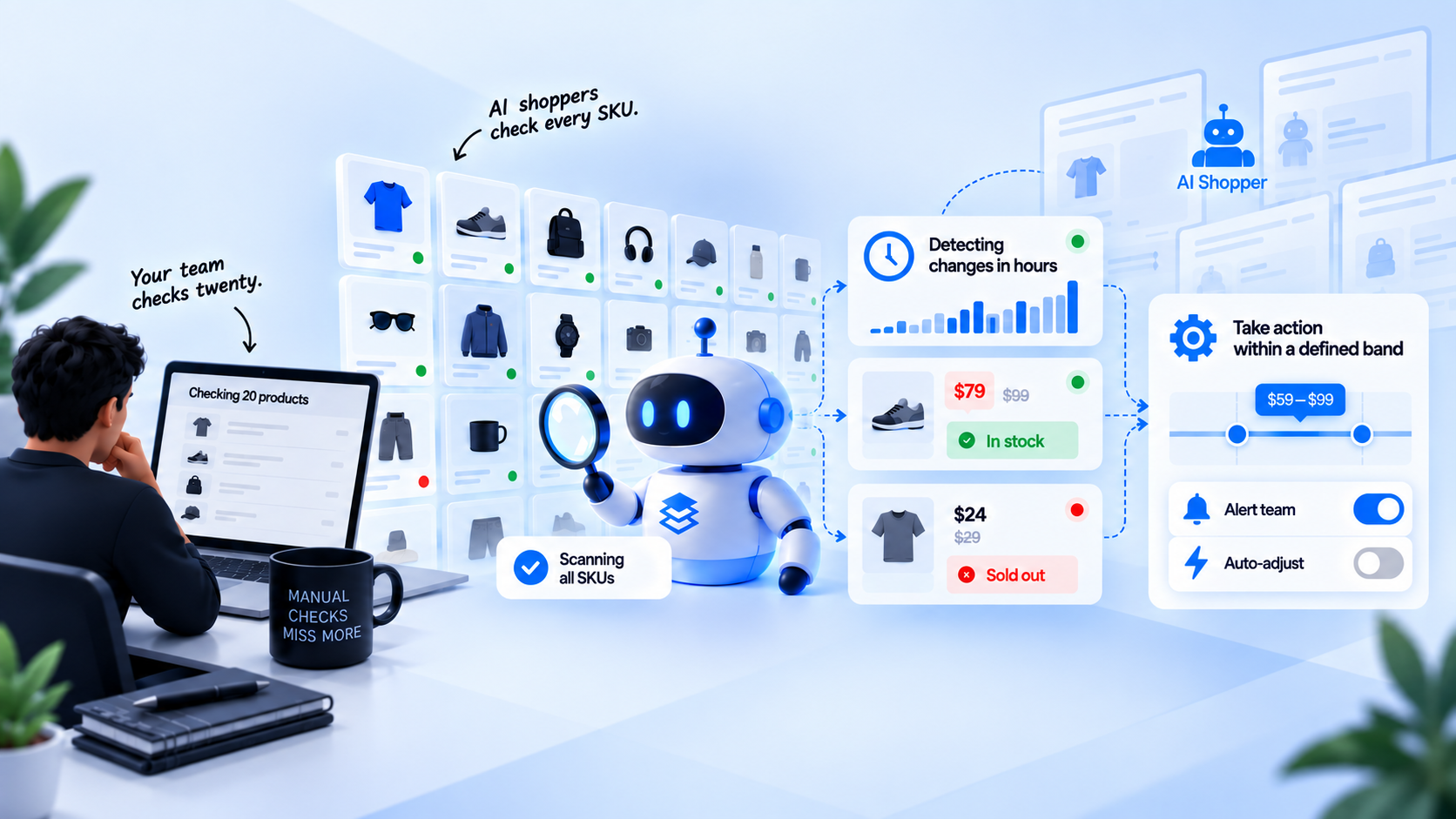
- Monitor the whole catalog, not a curated subset. The rationale for triaging down to bestsellers was that nobody compared the rest. That assumption expired.
- Detect changes on a cycle measured in hours. The Fed data shows competitor repricing as a slow migration rather than an event. Slow migrations are only visible if you're sampling continuously; a fortnightly check sees noise.
- Correlate price with context. A competitor's price on an item they've sold out of is not a threat. The same price on an item they just restocked is. Price data without stock data produces confident wrong conclusions rather than merely incomplete ones.
- Act inside a defined band. Either an alert to a human with authority to move, or a rule-bound automatic adjustment with a floor. Detection that reaches nobody is an expensive archive.
This is the same shape of failure covered in the phantom competitor problem: a feed that is technically accurate but structurally incomplete still produces a wrong conclusion. There, the missing signal was stock. Here, it's breadth — most of the catalog was never in the feed to begin with.
Find your own coverage gap
You can size this yourself in about ten minutes. Take your live SKU count, multiply by the number of competitors who genuinely carry overlapping assortment, and compare that number against how many price checks your team actually completes in a normal week. Most teams doing the arithmetic for the first time find the covered fraction is smaller than they'd have guessed, and that it clusters in the products that are easiest to check rather than the ones most exposed.
See your coverage gap. Send us your catalog size and competitor list and we'll return a one-page estimate of what's being watched today versus what isn't — no pitch attached, just the number and the method behind it. crawlify.ai/pilot · hello@crawlify.ai.
Frequently Asked Questions
